

Cool, deep, full-bodied – Tsuyu is one of the secret pillars of Japanese cuisine. This dark, aromatic sauce is often first encountered when dipping cold soba or sōmen noodles. But anyone who looks into its composition and origin quickly realizes: tsuyu is far more than just soy sauce with broth – it is an expression of Japanese flavor logic.
What is tsuyu?
Tsuyu (つゆ or 蕎麦つゆ) is a liquid seasoning sauce consisting of three main components:
-
Soy sauce (shoyu) – for saltiness and depth
-
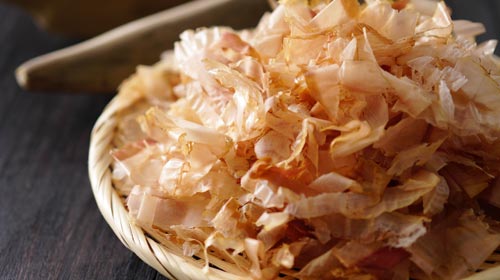
Dashi – a clear broth made from kombu (kelp) and katsuobushi (dried bonito)
-
Mirin or sugar – for a delicate sweetness and balance
The exact composition varies depending on its intended use. Tsuyu can be used as a dipping sauce (for cold noodles), as a soup base (e.g., for hot udon), or as a seasoning for rice dishes, vegetables, or fried foods. Depending on the application, it is diluted with water – classically in a ratio of 1:3 or 1:4.
Origin and development
The history of tsuyu is closely linked to the development of soba. As early as the Edo period (1603–1868), simple noodle soups and dips became established as urban fast food. Tsuyu sauce developed from the need to create a savory yet clear base that was quick to prepare and shelf-stable. The combination of fermented (soy sauce), dried (bonito), and fresh (mirin) ingredients became a hallmark of Japanese umami cuisine.
In old soba restaurants, tsuyu was often aged for days or weeks in small batches – a kind of “house broth,” with each establishment developing its own ratio and method. This tradition can still be found today in high-quality soba-ya.
What is tsuyu used for?
Tsuyu is not just for dipping – here are some classic applications:
-
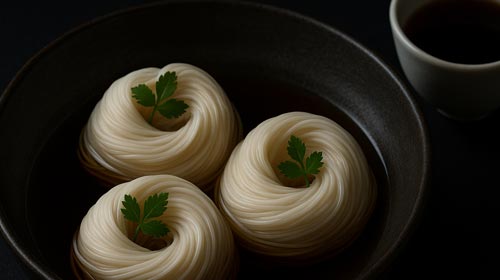
Zaru soba / Sōmen – cold noodles are dipped in cold tsuyu, often with scallions, wasabi, or grated ginger
-
Kake udon / Soba – diluted as a hot broth for hot noodle soups
-
Tamago toji don – egg-topped rice bowl seasoned with tsuyu
-
Nimono (braised vegetables) – vegetables or mushrooms are cooked in tsuyu broth
-
Tempura dip – slightly milder and sweeter, with additional daikon and mirin
Homemade or store-bought?
Supermarkets sell ready-made tsuyu – often called “mentsuyu.” It is convenient, but often contains additives and flavorings that have little to do with traditional taste. Anyone who wants to delve deeper prepares their own tsuyu. The basic recipe is simple:
Basic tsuyu:
-
200 ml soy sauce
-
200 ml mirin
-
10 g kombu
-
20 g katsuobushi
Bring the mirin and soy sauce to a boil, add the kombu and katsuobushi, let steep for a few minutes, strain – done. Store in the refrigerator; it will continue to mature.
The sauce can be varied with dried shiitake mushrooms, anchovies, or sardines (niboshi). Some swear by a splash of yuzu or sake.
Why is tsuyu so special?
Because it embodies the essence of Japanese cuisine: clarity, depth, umami, restraint. Tsuyu brings it all – without imposing itself. It combines mild with bold, sweet with salty, sea with land.
Especially in summer, cold tsuyu sauce is an essential component of many dishes. Anyone who has tried ice-cold sōmen with fresh tsuyu knows why Japan does not give up soups when it is 35 degrees.
Tsuyu is far more than just a noodle sauce – it is a base, dip, broth, and flavor carrier all in one. It is easy to make yourself, highly versatile, and always remains elegant. In its simplicity lies depth – typically Japanese. Anyone who wants to understand Japanese cuisine cannot get around it. And anyone who has made it properly once will never want anything else again.

Leave a comment
This site is protected by hCaptcha and the hCaptcha Privacy Policy and Terms of Service apply.