
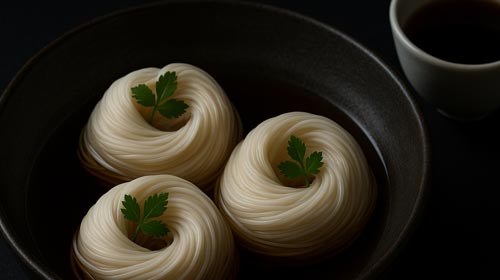
When the Japanese summer becomes hot and humid, many turn to a dish that is as simple as it is ingenious: Sōmen. These fine, almost silky wheat noodles are among Japan's oldest noodle varieties – and remain an integral part of summer meals, picnics, and family rituals to this day. But behind the apparent simplicity of sōmen lies much more than just a cool refreshment.
What exactly are sōmen?
Sōmen (素麺 or そうめん) are ultra-thin noodles made from wheat flour, water, and salt. They are pulled rather than rolled in a laborious process – giving them their characteristic tenderness and firm bite. After cooking, they are immediately shocked in ice-cold water to remove excess starch and firm up their texture. Traditionally, they are served on a bamboo mat or in ice water – cool, smooth, and minimalist.
Unlike udon or ramen, sōmen appear almost fragile. But their strength lies in their elegance. Especially on hot days, they offer a welcome relief: easy to digest, quick to prepare, and endlessly versatile.
The traditional way to eat sōmen
Sōmen are usually served with a dark dipping sauce called tsuyu – made from soy sauce, dashi, and mirin. This is accompanied by finely sliced spring onions, grated ginger, sometimes myoga (Japanese ginger), sesame seeds, or toasted nori strips. Everything is placed on the table – everyone dips to their liking.
A classic is also Nagashi-Sōmen, which is particularly popular with children: The cooked noodles are placed in a half-cut bamboo tube and “sent” downhill with cold water. Whoever can catch them with chopsticks may eat them. It is a summer game – and at the same time, a celebration of mindfulness.
Origins and history
The origins of sōmen date back to the Heian period (794–1185). Originally, they were a specialty of Buddhist monasteries and were made from mung bean flour. It was only later that the wheat variety we know today became established. The region of Miwa in Nara is particularly renowned for high-quality sōmen, where their production is still considered a craft to this day.
During the Edo period, sōmen became increasingly popular as an everyday dish, especially in summer. Even today, they are regularly prepared in many families – often simply, but with love.
Modern interpretations of sōmen
Many varieties have become established in today's cuisine:
-
Sōmen salad with tomato, cucumber, egg, and sesame
-
Cold sōmen with citrus dressing and coriander
-
Sōmen bowl with fermented tofu and pickled vegetables
-
Or even sweet sōmen with fruit syrup and mint – as a refreshing dessert
What unites them all is their lightness and versatility. Sōmen take on the flavors of their accompaniments without overpowering them. And that is exactly what makes them so popular – especially at a time when quick, light, and flexible dishes are in demand.
Sōmen are more than cold noodles – they are a piece of Japanese summer culture. With every bite, they tell of old traditions, craftsmanship, mindfulness, and the joy of appreciating the simple things. In a world full of overstimulation, they offer a moment of calm – cool, clear, and focused. And perhaps exactly what we really need in summer.


Leave a comment
This site is protected by hCaptcha and the hCaptcha Privacy Policy and Terms of Service apply.