
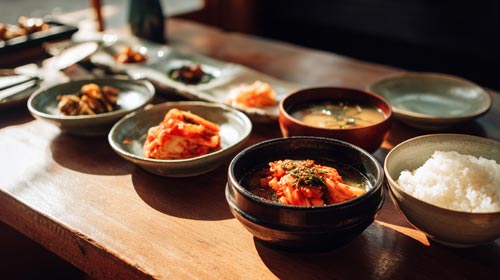
Washoku (和食) is the Japanese word for “traditional Japanese cuisine” – and at the same time the epitome of a deeply rooted food culture that goes far beyond taste and satiety. Washoku stands for balance, seasonality, mindfulness, and the quiet harmony between people, nature, and food. It is not a fixed menu – but an attitude.
In 2013, Washoku was recognized by UNESCO as an Intangible Cultural Heritage. Why? Because it encompasses not only dishes, but an entire worldview.
What does “Washoku” mean?
Literally translated, “Wa” (和) means something like “harmony” or “Japanese,” while “Shoku” (食) stands for “food” or “meal.” Washoku therefore means “harmonious food in the Japanese style”. This harmony is evident on several levels: in taste, in appearance, in nutritional balance, and in the social function of the meal.
The opposite would be “Yōshoku” (洋食) – Western-influenced cuisine such as curry rice or spaghetti napolitan, which also has its place in Japanese food culture, but does not fall under the concept of Washoku.
The four basic principles of Washoku
Respect for seasonality:
Ingredients are used at the peak of their natural ripeness. Each season brings new textures, colors, and aromas. For example, bamboo shoots symbolize spring, pumpkin late summer, and root vegetables winter.
-
Balanced composition:
A classic Washoku menu consists of “Ichijū-Sansai” – a soup (usually miso) and three side dishes:-
A main dish (fish or tofu)
-
Two side dishes (e.g., vegetables, Tsukemono, salads)
Rice is added as the center of the meal. The idea: variety without overload.
-
-
Natural preparation:
The inherent flavor of the ingredients is to be preserved. Frying, grilling, steaming – yes, but never overseasoning. Herbs, broths, and fermented seasonings (miso, soy sauce, mirin) bring depth without dominating. -
Aesthetics and appreciation:
Colors, shapes, dishes, presentation – everything follows the idea of understated elegance (Shibui). One eats with the eyes. Every component is consciously chosen and is intended not only to nourish but also to touch.
Central components of Washoku cuisine
-
Rice (Gohan): The foundation of every meal. White, steamed, simple.
-
Dashi: The basic broth made from kombu and katsuobushi, the foundation of almost all soups and sauces.
-
Miso: Fermented soybean paste, versatile and full of umami.
-
Soy sauce, mirin, sake: The “holy trinity” of Japanese seasoning.
-
Tsukemono: Pickled vegetables – to cleanse the palate and create contrast.
-
Fish, tofu, seaweed, seasonal vegetables: The main players on the plate. Meat traditionally plays a supporting role.
Washoku is more than cooking
Washoku is also a social practice. Meals are eaten together, often in peace, with gratitude – expressed by “Itadakimasu” before the meal and “Gochisōsama” afterward. It essentially means: “Thank you for this food and everyone who contributed to it.”
The avoidance of waste (Mottainai) also plays a major role: One uses as much of the product as possible, creatively repurposes leftovers, and pays attention to small portions.
Washoku today
While many modern cuisines are globalized and industrialized, Washoku remains a counterpoint: local, artisanal, seasonal. At the same time, it is open to new influences. In Japan itself, its own food culture is experiencing a renaissance – young chefs are reviving old techniques, working with regional products, and bringing Washoku into modern forms.
Interest is also growing internationally. Anyone who explores authentic Japanese cuisine – beyond sushi and ramen – will sooner or later encounter the principles of Washoku.
Washoku is not a diet, a trend, or a rigid tradition. It is a living concept that places respect, harmony, and mindfulness at the center – toward the ingredients, nature, and the people at the table.
Anyone who has once eaten a Washoku menu understands: It is not about becoming full. It is about connecting – with the moment, the taste, and the world that made it possible.


Leave a comment
This site is protected by hCaptcha and the hCaptcha Privacy Policy and Terms of Service apply.