
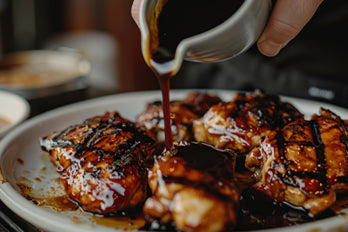
Soy sauce is to Japanese cuisine what salt is to many other cultures – indispensable. But what many do not know: genuine, artisan-brewed soy sauce (Shōyu) from Japan is a product full of depth, tradition, and precision. Far removed from industrial mass-produced products, small breweries still exist that ferment for months or even years – using wooden barrels, spring water, and centuries-old knowledge.
Origin and History
The roots of soy sauce lie in China, but in Japan, a distinct culture surrounding this seasoning developed from the 13th century onwards. Initially used in monasteries, its production became professionalized during the Edo period. Places such as Noda or Yuasa became known for their high-quality soy sauces, which soon gained appreciation throughout Japan.
Traditional Production
Genuine Shōyu consists of only four ingredients: soybeans, wheat, salt, and water. First, koji is made – a noble mold that breaks down the starch in the wheat and the protein in the beans. The resulting koji is mixed with brine and fermented in large wooden barrels, called kioke, to create moromi mash. Depending on the quality, this process takes at least one year – some producers even let their soy sauce mature for several years.
After fermentation, the liquid is pressed, possibly lightly heated, and bottled. The result is a deep, rounded aroma with complex umami notes.
Famous Soy Sauce Breweries in Japan
Yamaroku Shoyu – Shodoshima
The island of Shodoshima is known for its soy sauce tradition. Yamaroku uses over 100-year-old kioke barrels. Specialty: Tsuru Bishio – velvety, almost balsamic.
Price: from approx. €15–25 per 500 ml
Yuasa Shoyu – Wakayama
In Yuasa, the birthplace of Japanese soy sauce, Yuasa Shoyu is produced traditionally using spring water and two years of maturation.
Price: €20–30 per 500 ml
Daitoku Shoyu – Hyogo
Certified organic, made with local soybeans and heirloom wheat varieties in hand-operated wooden barrels.
Price: €12–18 per 500 ml
Marusho Soy Sauce – Kyoto
Specializes in light Usukuchi-Shōyu, which is used in refined Kaiseki cuisine. Price: €10–20 per 300–500 ml
Kikkoman (Premium Saishikomi Line)
Apart from industrial products, Kikkoman offers a double-fermented specialty soy sauce in Japan.
Price: €8–15 per 300 ml
Soy sauce is to Japanese cuisine what salt is to many other cultures – indispensable. But what many do not know: genuine, artisan-brewed soy sauce (Shōyu) from Japan is a product full of depth, tradition, and precision. Far removed from industrial mass-produced products, small breweries still exist that ferment for months or even years – using wooden barrels, spring water, and centuries-old knowledge.
Differences Between Soy Sauce Types
- Koikuchi: dark, balanced standard sauce, universally applicable
- Usukuchi: light, but salty – perfect for clear broths and vegetables
- Tamari: thick, with little to no wheat – especially for sushi or gluten-free cuisine
- Saishikomi: double-fermented, very aromatic and deep
What to Look for When Buying?
- Only natural ingredients: soybeans, wheat, salt, water
- Indication of traditional fermentation (e.g., 1 year or more)
- Unpasteurized or minimally processed
- The producer should be clearly stated
Genuine Japanese soy sauce is not an industrial byproduct, but fermented craftsmanship. Its depth, elegance, and balance of flavors make it a central element of Washoku cuisine. Anyone who has tried traditionally made Shōyu once will never want to touch industrial alternatives again.
Soy sauce is not simply salty – it is a poem of umami, patience, and Japanese fermentation art.


Leave a comment
This site is protected by hCaptcha and the hCaptcha Privacy Policy and Terms of Service apply.