
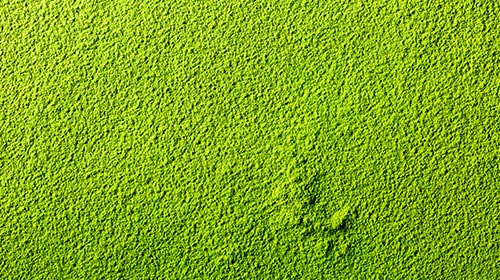
When you think of matcha, you often think of Japan – and rightly so. For hardly any country cultivates the art of powdered green tea with as much dedication as Japan. Yet, away from industrial mass production, true treasures are created on small organic tea farms: organic matcha, cultivated in accordance with the requirements of the respective organic standard and processed with great care.
These organic farms, often family-run for generations, are located in mountainous regions such as Uji, Kirishima, Kagoshima, or Shizuoka – far from the hustle and bustle of urban life and environmental pollution. Here, the conditions are ideal for Camellia sinensis: mineral-rich volcanic soils, high humidity, dense fog, and cool nights. This is exactly what the tea plant loves.
But organic means more than just “pesticide-free” in Japan. The soils are built up over years with compost, organic tea residues, and microorganisms. Between the tea rows, a vibrant mix of wild plants often grows, which stabilizes the microclimate and keeps pests away. No monoculture, but a finely tuned ecosystem.
Many of these farms operate according to the principles of permaculture or even biodynamics – an approach that is rare in Japan but is attracting increasing interest. Tea farmers such as Kazu Hattori or the Morimoto family are pioneers of this movement. They consistently refrain from using chemical aids and instead turn to natural solutions: tea bowl broth to strengthen the leaves, wood ash against fungal infections, or fermented rice to promote the soil flora.
The harvest is traditionally done by hand, often assisted by light machinery, but never in a rush. Only the most tender leaves from the first harvest – the so-called Ichibancha – are used for high-quality organic matcha. Before the harvest, the tea bushes are shaded for two to four weeks. This stimulates the formation of chlorophyll and theanine – responsible for the bright green color and the velvety umami flavor of the matcha.
After the harvest, the leaves are gently steamed, dried, and stripped of stems and veins. The so-called tencha is the precursor to matcha. Only shortly before shipping is it slowly ground into the finest powder in traditional granite stone mills – no faster than 40 g per hour. Why? So that the matcha powder does not oxidize due to friction heat and lose its aromas.
What makes many of these organic farms special is the combination of certified cultivation, artisanal processing, and long-term experience. Many of them see themselves as guardians of a traditional tea culture – and at the same time as part of a new movement for transparency, mindfulness, and quality. They open their fields to visitors, openly share their knowledge, and work closely with young tea fans around the world.
The taste of high-quality organic matcha is unmistakable: mild, yet deep. Creamy, nutty, without bitterness. No comparison to conventional varieties. And yet, it is about more than taste – it is about attitude. About responsibility. About the connection between tradition and the future.
So the next time you drink matcha, ask yourself: Where does my tea come from? Who grew it? And how was it treated – as a mere product or as a living expression of nature, culture, and patience?
Organic matcha from Japan shows how certified cultivation, tea tradition, and artisanal processing can be combined.

Leave a comment
This site is protected by hCaptcha and the hCaptcha Privacy Policy and Terms of Service apply.