
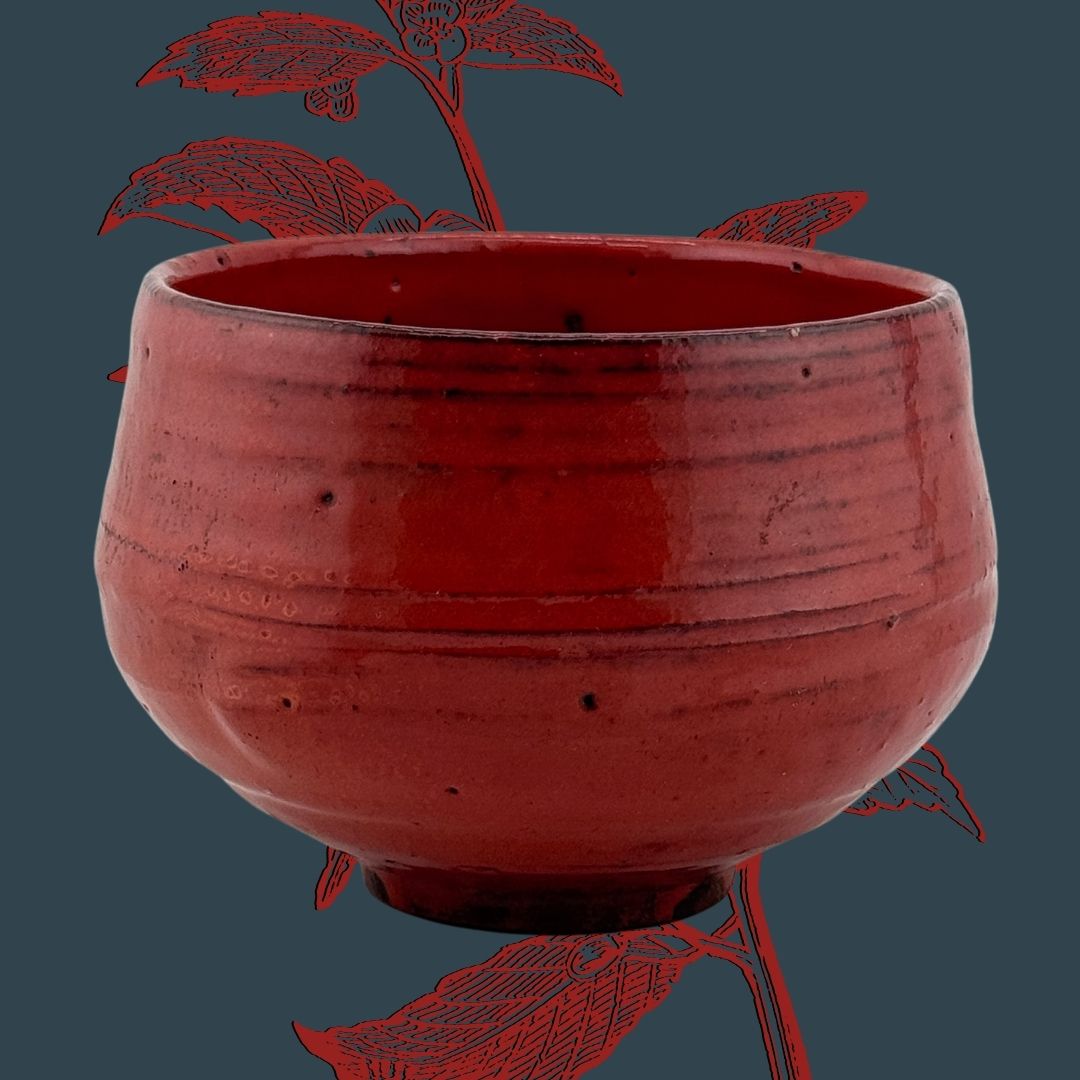
Aka-Raku Chawan – vermilion Japanese matcha bowl from the Shōwa era

Aka-Raku Chawan – Red Raku Japan, early to mid-Shōwa period This deep red chawan glows as if it has stored the warmth of the fire within itself. The glaze displays a lively interplay of bright red, dark smoky shades, and a finely woven network of crazing (貫入 kannyū), which is typical of older Aka-Raku works. The rim is deliberately irregular, the form slightly rounded, organic, and soft. It is precisely this imperfection that gives it its calm, wabi-sabi presence. Turning the bowl reveals a smooth red interior surface, whose depth is further enhanced by the crazing structures. The foot ring is darkly fired, dense, solid, and shows a clearly formed spiral in the center – a traditional feature of many Raku workshops around Kyoto. Artist's stamp – 手印 by the potter  The signature is not an engraved kanji, but a freely incised personal potter's mark (個人印 kojin-in). This type of signature is typical of smaller workshops that worked in the orbit of the Raku family tradition: expressive lines, spontaneous movement, no official seal geometry.The form of the engraving, the firing color of the foot, and the style of the glaze suggest that the bowl was created in the early to mid-Shōwa period (昭和初期〜中期, ca. 1930–1960).Regional characteristics such as the clay color, form, and glaze application clearly point to Kyoto / 楽焼系 Raku schools. Style & Atmosphere This Aka-Raku bowl radiates an immediate warmth. Its red does not appear decorative, but pulsating – almost like a glowing surface that has solidified in the kiln for a few seconds. The small iron spots, the flowing color transitions, and the fragrant smoky tone in the upper area show a craftsmanship freedom that is only possible with genuine Raku ceramics.It is ideal for strong matcha, tea ceremonies in a quiet setting, or as a collector's item with a distinct historical character. Historical Classification Early to mid-Shōwa period (1930–1960)Characterized by glowing Aka-Raku glazes, dark firing zones, organic forms, expressive free artist engravings, and finely pronounced kannyū on the interior. Regional Classification Kyoto / SurroundingsClearly attributable to the extended school of 楽焼 Raku ceramics, but not from the direct main line of the Raku family, but from workshops that worked in their style and used their own potter's marks. Details • Material: Raku ceramics (楽焼)• Type: Aka-Raku Chawan 赤楽茶碗• Age: early to mid-Shōwa period (1930–1960)• Glaze: deep red-hot fire color (火色) with dark smoky zones• Interior: fine, fully developed crazing (貫入)• Form: slightly rounded, soft, organic• Rim: deliberately irregular, traditionally hand-formed• Kodai: darkly fired, with a pronounced spiral form• Signature: free artist engraving 個人印• Origin: Kyoto region• Style: Wabi-Sabi, traditional Raku aesthetics• Ideal for: Matcha, ceremonies, collectors of Japanese ceramics This bowl stands in a tradition of tea enjoyment that has been cultivated for generations.
read more
Sale price€399,90 EUR
In stock Delivery within Germany: 3–5 working days Free shipping
Waitlist

Let me know when it is back.

We will send you one email as soon as this item is available again.

Aka-Raku Chawan – zinnoberrote japanische Matchaschale aus der Shōwa-Zeit – Ansicht 1
Aka-Raku Chawan – vermilion Japanese matcha bowl from the Shōwa era €399,90

One availability email only. No newsletter. Privacy

FAQ

Was ist Aka-Raku Chawan – zinnoberrote japanische Matchaschale aus der Shōwa-Zeit?
Aka-Raku Chawan – 赤の息 Japan, frühe bis mittlere Shōwa-Zeit Diese tiefrote Chawan leuchtet, als hätte sie die Wärme des Feuers in sich gespeichert.
Woher stammt diese Matcha Schale und wie ist sie gefertigt?
Aka-Raku Chawan – 赤の息 Japan, frühe bis mittlere Shōwa-Zeit Die Glasur zeigt ein lebendiges Spiel aus hellem Rot, dunklen Rauchschattierungen und einem fein geknüpften Craquelé-Netz (貫入 kannyū ), das typisch für ältere Aka-Raku-Arbeiten ist. Der Fußring ist dunkel gebrannt, dicht, fest und zeigt eine klar ausgeformte Spirale im Zentrum – ein traditionelles Merkmal vieler Raku-Werkstätten rund um Kyoto.
Aus welchem Material bzw. welchen Bestandteilen besteht diese Matcha Schale?
Die Glasur zeigt ein lebendiges Spiel aus hellem Rot, dunklen Rauchschattierungen und einem fein geknüpften Craquelé-Netz (貫入 kannyū ), das typisch für ältere Aka-Raku-Arbeiten ist. Die Form der Gravur, die Brennfarbe des Fußes und der Stil der Glasur legen nahe, dass die Schale in der frühen bis mittleren Shōwa-Zeit (昭和初期〜中期, ca.
Wie verwende ich diese Matcha-Schale bei der Zubereitung?
Kyoto / Umgebung Eindeutig der erweiterten Schule der 楽焼 Raku-Keramik zuzuordnen, jedoch nicht aus der direkten Hauptlinie der Raku-Familie, sondern aus Werkstätten, die nach ihrem Stil arbeiteten und eigene Töpfermarken verwendeten.
Welche Form, Glasur oder gestalterischen Merkmale hat diese Chawan?
• Material: Raku-Keramik (楽焼) • Typ: Aka-Raku Chawan 赤楽茶碗 • Alter: frühe bis mittlere Shōwa-Zeit (1930–1960) • Glasur: tiefes rotglühendes Feuerrot (火色) mit dunklen Rauchzonen • Innen: feines, vollständig ausgebildetes Craquelé (貫入) • Form: leicht bauchig, weich, organisch • Rand: bewusst unregelmäßig, traditionell handgeformt • Kodai: dunkel gebrannt, mit ausgeprägter Spiralform • Signatur: freie Künstlergravur 個人印 • Herkunft: Kyoto-Region • Stil: Wabi-Sabi, traditionelle Raku-Ästhetik • Ideal für: Matcha, Zeremonien, Sammler japanischer Keramik
Was ist bei Aka-Raku Chawan – zinnoberrote japanische Matchaschale aus der Shōwa-Zeit enthalten?
Sie ist ideal für kräftigen Matcha, Teezeremonien im stillen Rahmen oder als Sammlerstück mit deutlicher geschichtlicher Handschrift. Material: Raku-Keramik (楽焼) • Typ: Aka-Raku Chawan 赤楽茶碗 • Alter: frühe bis mittlere Shōwa-Zeit (1930–1960) • Glasur: tiefes rotglühendes Feuerrot (火色) mit dunklen Rauchzonen • Innen: feines, vollständig ausgebildetes Craquelé (貫入) • Form: leicht bauchig, weich, organisch • Rand: bewusst unregelmäßig, traditionell handgeformt • Kodai: dunkel gebrannt,

Product description

Aka-Raku Chawan – Red Raku Japan, early to mid-Shōwa period

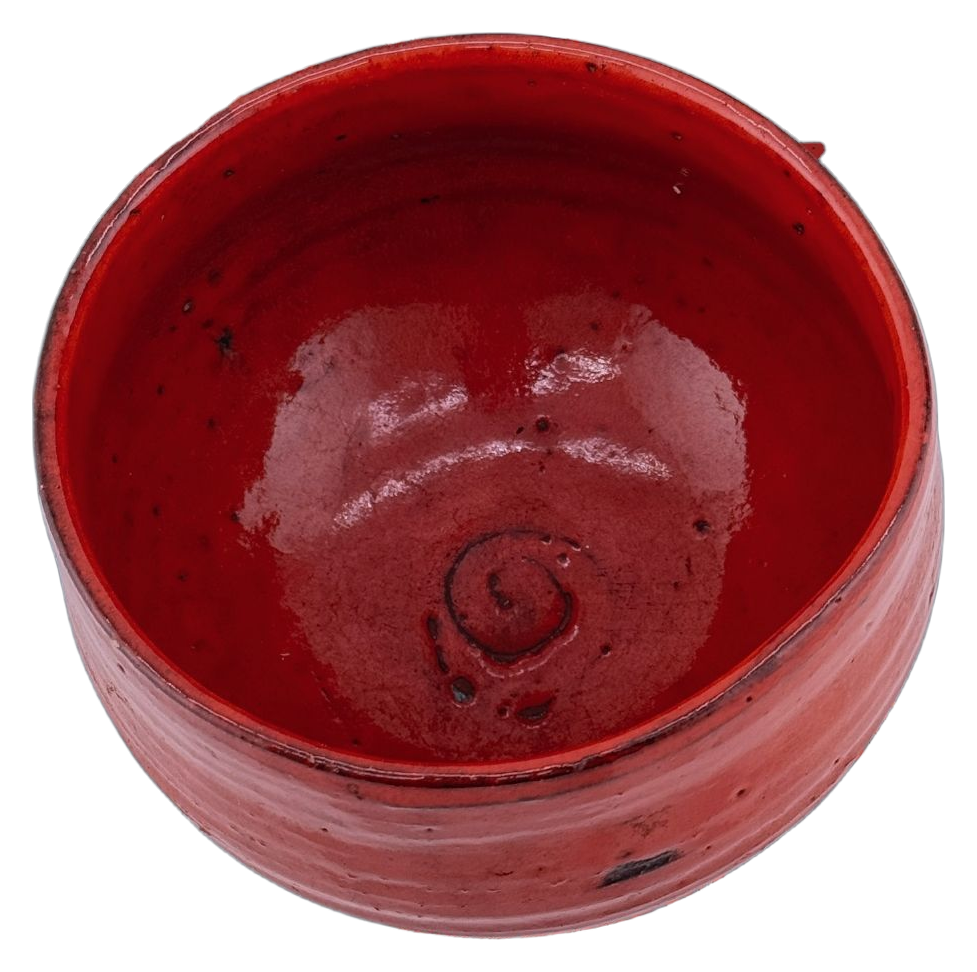
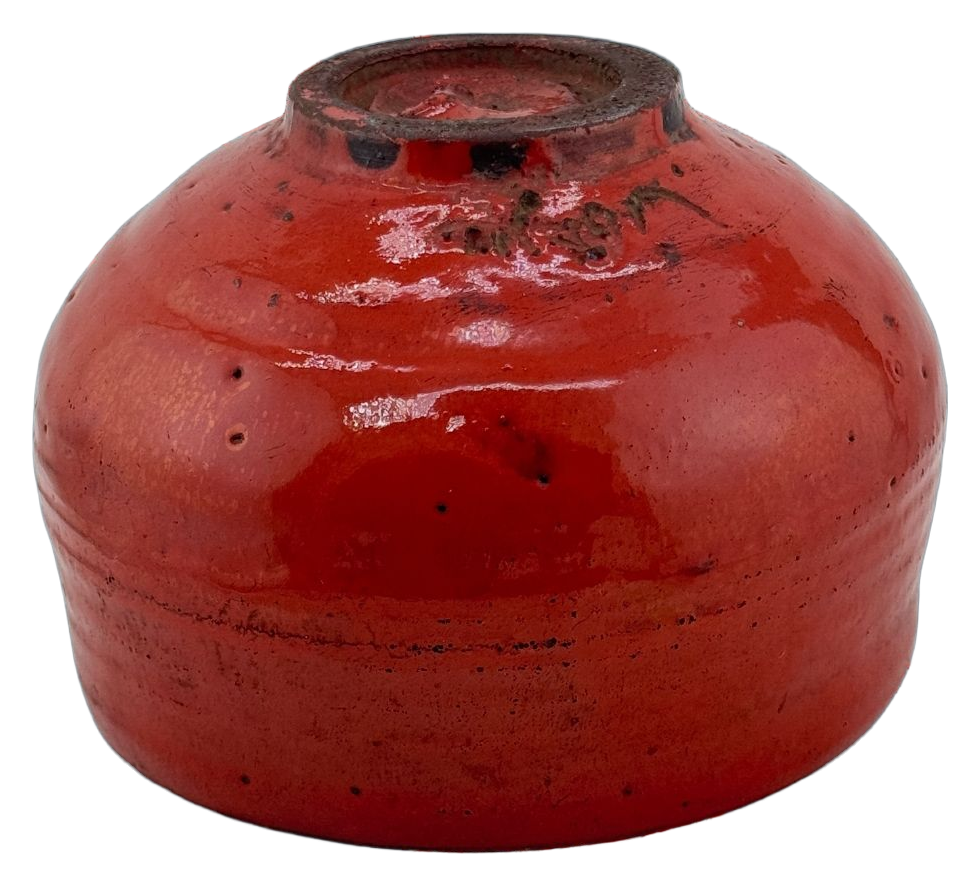
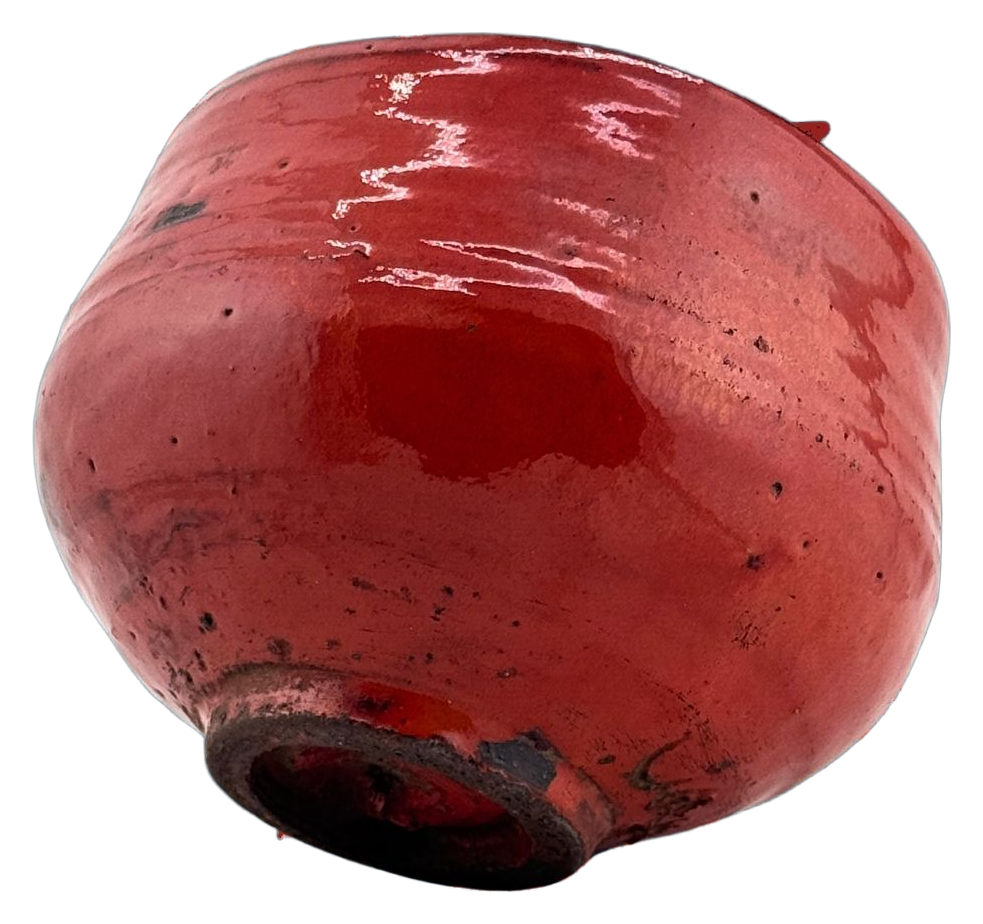
This deep red chawan glows as if it has stored the warmth of the fire within itself. The glaze displays a lively interplay of bright red, dark smoky shades, and a finely woven network of crazing (貫入 kannyū), which is typical of older Aka-Raku works. The rim is deliberately irregular, the form slightly rounded, organic, and soft. It is precisely this imperfection that gives it its calm, wabi-sabi presence.

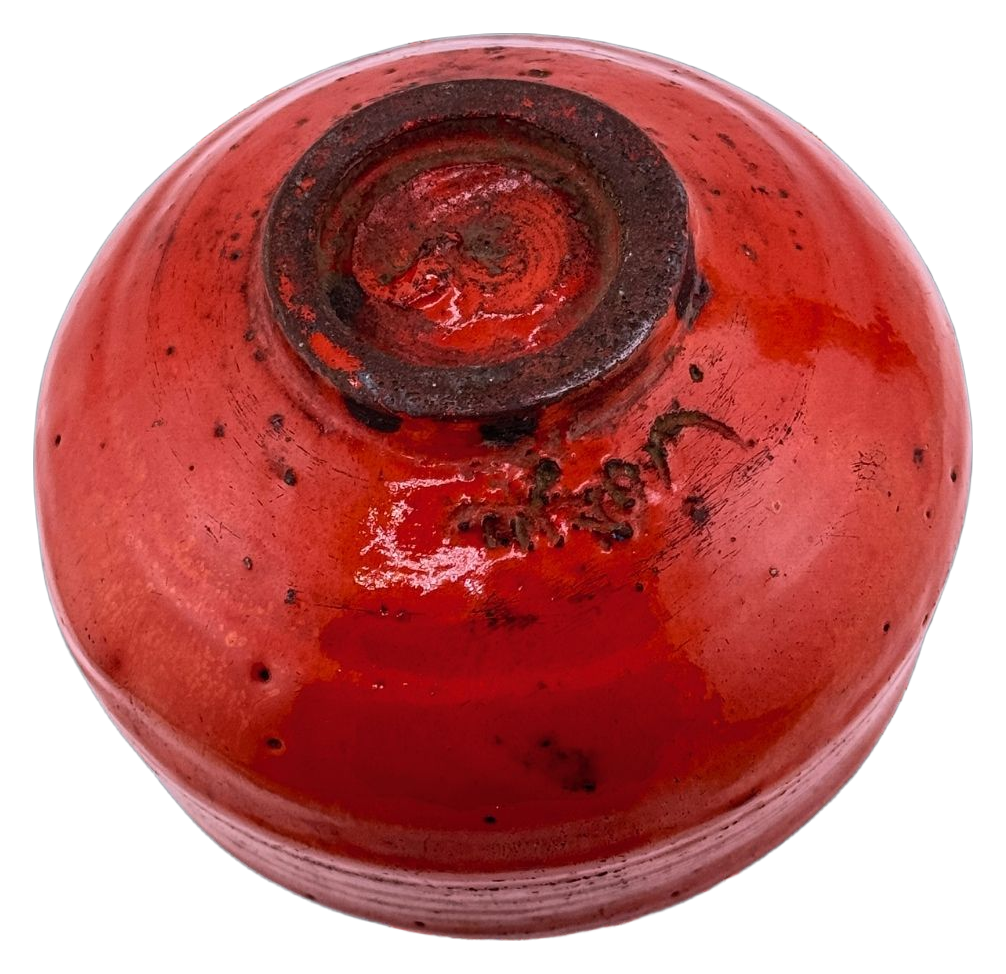
Turning the bowl reveals a smooth red interior surface, whose depth is further enhanced by the crazing structures. The foot ring is darkly fired, dense, solid, and shows a clearly formed spiral in the center – a traditional feature of many Raku workshops around Kyoto.

Artist's stamp – 手印 by the potter 

The signature is not an engraved kanji, but a freely incised personal potter's mark (個人印 kojin-in). This type of signature is typical of smaller workshops that worked in the orbit of the Raku family tradition: expressive lines, spontaneous movement, no official seal geometry.
The form of the engraving, the firing color of the foot, and the style of the glaze suggest that the bowl was created in the early to mid-Shōwa period (昭和初期〜中期, ca. 1930–1960).
Regional characteristics such as the clay color, form, and glaze application clearly point to Kyoto / 楽焼系 Raku schools.

Style & Atmosphere

This Aka-Raku bowl radiates an immediate warmth. Its red does not appear decorative, but pulsating – almost like a glowing surface that has solidified in the kiln for a few seconds. The small iron spots, the flowing color transitions, and the fragrant smoky tone in the upper area show a craftsmanship freedom that is only possible with genuine Raku ceramics.
It is ideal for strong matcha, tea ceremonies in a quiet setting, or as a collector's item with a distinct historical character.

Historical Classification

Early to mid-Shōwa period (1930–1960)
Characterized by glowing Aka-Raku glazes, dark firing zones, organic forms, expressive free artist engravings, and finely pronounced kannyū on the interior.

Regional Classification

Kyoto / Surroundings
Clearly attributable to the extended school of 楽焼 Raku ceramics, but not from the direct main line of the Raku family, but from workshops that worked in their style and used their own potter's marks.

Details

• Material: Raku ceramics (楽焼)
• Type: Aka-Raku Chawan 赤楽茶碗
• Age: early to mid-Shōwa period (1930–1960)
• Glaze: deep red-hot fire color (火色) with dark smoky zones
• Interior: fine, fully developed crazing (貫入)
• Form: slightly rounded, soft, organic
• Rim: deliberately irregular, traditionally hand-formed
• Kodai: darkly fired, with a pronounced spiral form
• Signature: free artist engraving 個人印
• Origin: Kyoto region
• Style: Wabi-Sabi, traditional Raku aesthetics
• Ideal for: Matcha, ceremonies, collectors of Japanese ceramics

This bowl stands in a tradition of tea enjoyment that has been cultivated for generations.